












September 2026 | Metro Vancouver
The summer 2026 real estate market ended on a softer note, with sales continuing to trail last year and well below historical averages.
According to the Greater Vancouver REALTORS® (GVR), 1,869 homes sold in Metro Vancouver in August, down 4.6% from August 2025 and 20.7% below the 10-year seasonal average of 2,356 sales.
The result confirms that buyers remain cautious, despite increased choice, more stable mortgage rates and declining prices.
More inventory. Fewer buyers.
There were 4,100 new listings added to the market in August, down 3% from last year and slightly below the 10-year average.
At the end of August, buyers had 15,798 properties to choose from—26.2% more than the long-term average, although slightly fewer than August 2025.
This combination of slower sales and elevated inventory is keeping the market tilted toward buyers.
The overall sales-to-active-listings ratio was 12.3% in August:
- Detached: 9.6%
- Townhomes: 15.1%
- Apartments: 13.7%
Historically, sustained ratios below 12% tend to create downward pressure on prices, while ratios above 20% can create upward price pressure.
Home prices continue to soften
The Metro Vancouver composite benchmark price is now $1,081,900, down 5.6% from August 2025 and 0.6% from July.
By property type:
| Property Type | August 2026 Benchmark | YoY Change | Monthly Change |
|---|---|---|---|
| Detached | $1,799,400 | ↓ 7.2% | ↓ 1.3% |
| Townhouse | $1,028,800 | ↓ 4.4% | ↓ 0.2% |
| Apartment | $686,200 | ↓ 6.6% | ↓ 0.3% |
| All Residential | $1,081,900 | ↓ 5.6% | ↓ 0.6% |
Detached homes experienced the largest annual price decline, while apartment prices have also continued to move lower.
Why is the market so soft?
GVR Chief Economist Andrew Lis says the market performed roughly as expected through the first four months of 2026, but sales have lagged the January forecast since May, and GVR expects that trend to continue through the end of the year.
Several factors are contributing to the cautious market:
- Slower population and immigration growth
- Reduced investor demand
- Mortgage rates that remain too high to stimulate strong buying activity
- Continued economic uncertainty
- Renewed trade tensions with the United States
Interestingly, stable mortgage rates, declining prices and ample selection would normally create attractive conditions for buyers. Yet many buyers remain on the sidelines.
What does this mean for buyers?
Opportunity is emerging—but patience and selectivity matter.
Buyers currently have more negotiating power, considerably more choice than the long-term average, and less pressure to compete in multiple-offer situations.
For well-priced properties, however, the best opportunities may still attract competition.
The key is not simply finding a property that has dropped in price. It is finding the right property at the right price with the right terms.
What does this mean for sellers?
Pricing strategy has never been more important.
In a market where buyers have plenty of alternatives, an overpriced home can quickly become overlooked.
Today’s successful sellers need to compete—not just with the properties that sold
yesterday, but with everything a buyer can choose from today.
That means establishing the right price from the beginning, presenting the property exceptionally well, creating strong initial exposure and monitoring buyer response closely.
Our Take
The Vancouver market is not frozen—but buyers are being selective, and sellers are having to adjust to a new reality.
The most important market statistic isn’t necessarily the headline price decline. It’s the relationship between supply, demand and buyer behaviour.
With sales 20.7% below the 10-year average and inventory still 26.2% above its long-term average, the market continues to favour buyers.
For buyers, this can create opportunity.
For sellers, it reinforces the importance of strategy over optimism.
Download GVR’s August 2026 MLS® Residential Market Report.
– – –
As for the rest of the province …

Slow but Steady Sales Recovery Continues in the BC Market
Vancouver, BC – September 14, 2026. The British Columbia Real Estate Association (BCREA) reports that 5,653 residential unit sales were recorded in Multiple Listing Service® (MLS®) Systems in August 2026, down 4.7 per cent from August 2025. The average MLS® residential price in BC in August 2026 was down 1 per cent at $924,826 compared to $925,917 in August 2025.
Total MLS® residential sales dollar volume was $5.2 billion, down 4.8 per cent from the same time the previous year. BC MLS® unit sales were 25.4 per cent lower than the ten-year average for the month of August.
“Provincial home sales remain well below long-term averages but have been steadily improving throughout the year,” said BCREA Chief Economist Brendon Ogmundson. “We expect a gradual recovery in sales to continue, though new tariffs and a recent spike in long term interest rates add a layer of risk to that scenario.”
Year-to-date, BC residential sales dollar volume is down 6.5 per cent to $43.26 billion, compared with the same period in 2025. Residential unit sales are down 5.5 per cent year over-year at 46,069 units, while the average MLS® residential price is down 1 per cent to $939,028.
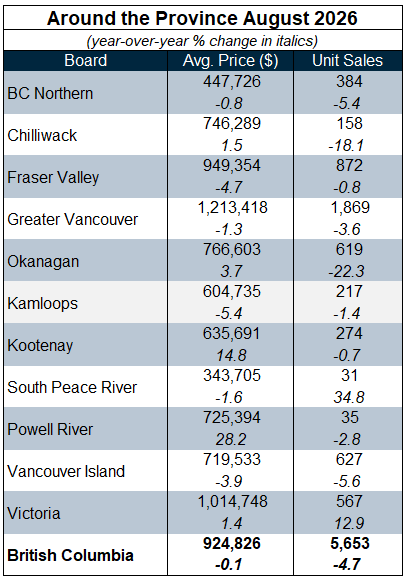
For the complete statistics release, including detailed tables, click here.


